
The Ultimate AI Prompt Cheat Sheet for Web Developers & SaaS Builders (2026 Guide)
Nileshblog.Tech
Jun 4, 2026 · 6 min read
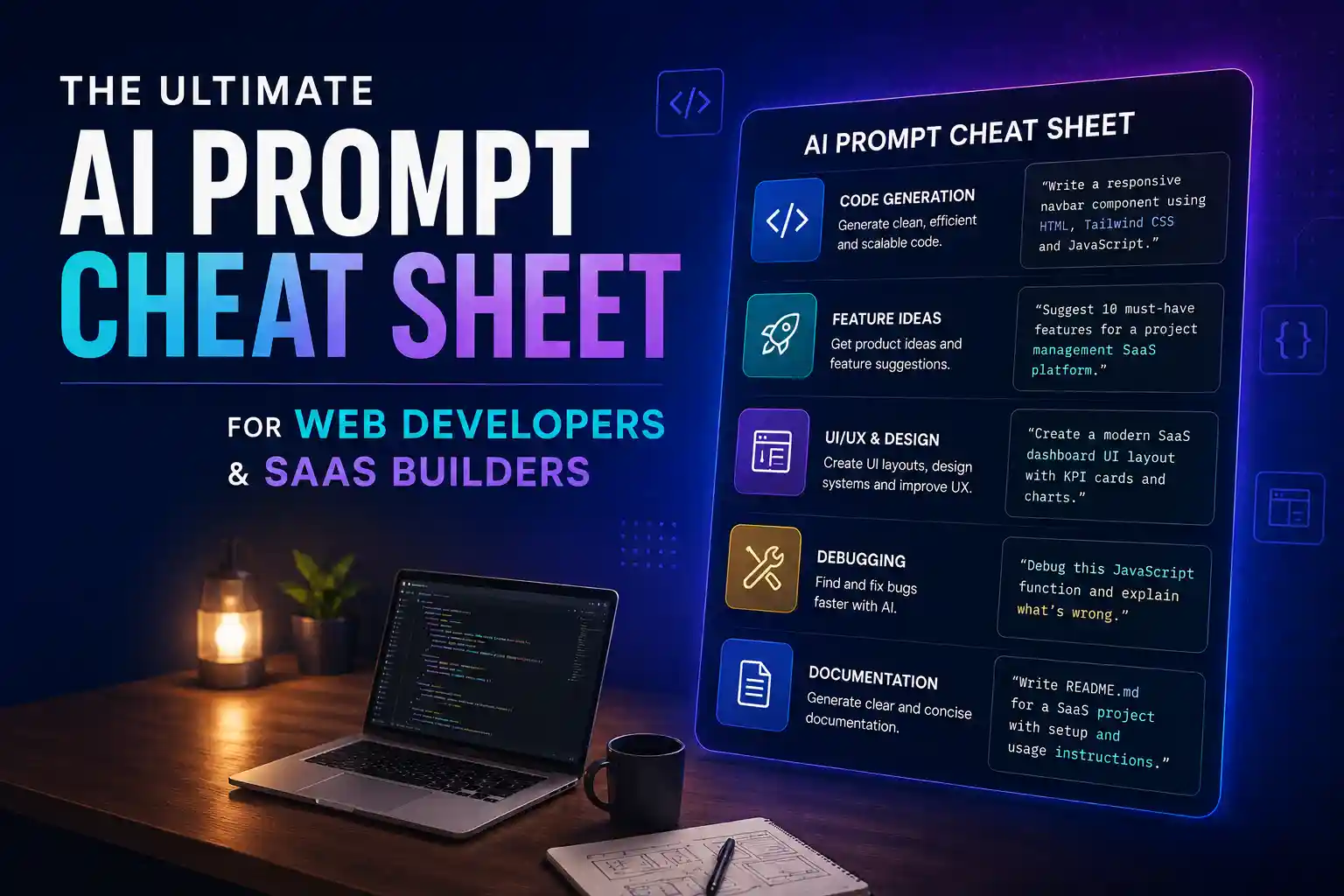
Let’s be honest: most developers are severely underutilizing AI.
We use it as a glorified autocomplete, asking it to write a simple function or fix a syntax error. But when you treat LLMs (like ChatGPT, Claude, or Gemini) as senior engineering partners, your output scales exponentially.
The secret isn’t the model you use. It’s the prompt architecture.
When you provide the right context, constraints, and tech-stack specifics, AI goes from writing generic boilerplate to generating production-ready components, scalable backend architectures, and complete Micro-SaaS frameworks.
If you are building a SaaS or working full-stack, bookmark this page. Here is your definitive, copy-paste prompt cheat sheet for every stage of development.
The "Dev-Prompt" Architecture
Before we get to the cheat sheet, you need to understand the anatomy of a perfect developer prompt. Never ask an AI to "write a feature." Instead, give it the C.S.C. framework:
- Context: What are we building and who is it for?
- Stack: What exact technologies, libraries, and design patterns are we using?
- Constraints: What should the AI avoid doing? (e.g., "Use functional components only," "Ensure free-tier architecture," "Make it mobile-first.")
1. Frontend & UI Component Prompts
A bad frontend prompt gives you messy, inline-styled code that breaks on mobile devices. A great prompt gives you a responsive, accessible component ready for production.
The Mobile-First React Component
Use this when you need a complex UI element that prioritizes mobile users.
Act as a Senior React Engineer.
Build a responsive dashboard sidebar component.

Tech Stack: React, Tailwind CSS, TypeScript.
Constraints:
- The architecture MUST be mobile-first.
- On mobile, it should be a bottom-navigation bar. On desktop, it should be a collapsible left sidebar.
- Use Lucide-react for icons.
- Ensure strict TypeScript typing for the navigation props.
- Do not use class components; use functional components and hooks only.

Provide the complete, copy-pasteable code.
The State Management Refactor
Use this when your component is passing too many props and becoming unmanageable.
Act as a Frontend Architect.
Review the following React component code. It currently suffers from severe prop-drilling.

Task: Refactor this component using the React Context API to manage the state cleanly.
Requirements:
- Create the Provider and the custom hook (e.g., `useDashboardState`).
- Separate the UI rendering from the business logic.
- Keep the code modular.

[INSERT YOUR COMPONENT CODE HERE]
2. Backend & API Design Prompts
Backend prompting requires strict boundaries to ensure the AI doesn't introduce security vulnerabilities or inefficient database queries.
The Scalable REST API Endpoint
Use this to generate standard CRUD operations with built-in validation.
Act as a Principal Backend Engineer.
Write a Node.js/Express REST API endpoint for user registration.

Tech Stack: Node.js, Express, MongoDB (Mongoose), Zod (for validation).
Requirements:
- Implement password hashing using bcrypt.
- Return a signed JWT token upon successful creation.
- Include robust error handling (try/catch) and return appropriate HTTP status codes.
- Validate the incoming request body using Zod before processing.
- Do not use deprecated Mongoose methods.
The System Design & Architecture Planner
Building for high concurrency? Have the AI map out the architecture before you write a single line of code.
Act as a Senior Cloud Architect.
I am designing a high-concurrency notification system for a SaaS app.

Requirements:
- We need to handle 10,000+ notifications per minute.
- We need to decouple the background processing from the main application thread.

Task: Propose an architecture using Redis (for caching/rate-limiting) and Kafka (for the message queue).
Format your response with:
1. High-level data flow.
2. How partitioning and sharding will be handled to scale.
3. Potential bottlenecks and how to mitigate them.
3. Micro-SaaS Ideation & Structuring
When building a Micro-SaaS—especially tools targeting local businesses—keeping overhead costs low is critical. Use AI to architect your MVP within free-tier limits.
The "Free Architecture" MVP Builder
Perfect for validating local business software without spending money on hosting.
Act as a Technical SaaS CTO.
I am building a Micro-SaaS called "Digital Tuition Manager"—a mobile-friendly web app for local tutors to manage student attendance and fee payments.

Task: Design a completely free-tier architecture stack for this MVP.
Requirements:
- Suggest a free frontend hosting solution.
- Suggest a free database tier capable of handling ~500 concurrent users.
- Suggest a free or highly generous backend-as-a-service (BaaS) or serverless environment.
- Provide a step-by-step roadmap for building the MVP in under 14 days.
The Database Schema Generator
Get your database relationships right the first time.
Act as a Database Administrator.
Design a NoSQL database schema (MongoDB) for the Digital Tuition Manager app.

Entities needed:
- Tutors (Users)
- Students
- Attendance Records
- Payment/Fee Logs

Requirements:
- Optimize the schema for fast read operations on the "Tutor Dashboard."
- Show whether data should be embedded or referenced based on MongoDB best practices.
- Provide the exact Mongoose schema models in JavaScript.
4. QA, Debugging, and Issue Resolution
Stop pasting generic "fix this code" prompts. Professional engineers use structured bug reports to get precise fixes.
The "Path to Reproduce" Debugger
When an application behaves unexpectedly, force the AI to analyze the exact sequence of events.
Act as a Senior QA Automation Engineer and System Debugger.
Analyze the following bug report for my web application.

Path to Reproduce:
1. User logs into the dashboard.
2. User navigates to the 'Automation Settings' tab.
3. User toggles the 'Enable Auto-Sync' button.
4. User refreshes the page.

Observed Behavior: The toggle reverts to 'off' and the state does not persist in the database, throwing a 400 Bad Request error in the console.

Task:
1. Identify the most likely root causes (Frontend state vs. Backend sync).
2. Provide the specific code to fix the database persistence issue.
3. Suggest a test case to ensure this regression does not happen again.

[INSERT RELEVANT COMPONENT/CONTROLLER CODE HERE]
The Regex & Data Parsing Wizard
Never struggle with writing complex Regular Expressions manually again.
Act as a Senior Developer.
Write a highly optimized Regular Expression (Regex) in JavaScript to extract specific data from a string.

Target data: I need to extract the date (YYYY-MM-DD) and the transaction amount from strings formatted like this: "Payment received on 2026-03-15 for the amount of $1,250.00 USD."

Provide:
1. The exact Regex.
2. A brief, plain-English explanation of how the pattern works.
3. A JavaScript function testing the Regex against 3 different edge cases.
Bookmark and Build
Prompt engineering isn't a fad; it is the new standard of developer productivity. By combining your deep technical knowledge with these structured constraints, you stop fighting the AI and start orchestrating it.
Copy these templates, adjust the tech stacks to fit your current project, and watch your development velocity double.